
This is a translated version of an article originally published in Korean on July 2nd, 2025 on the Korean Jungto Society Website (https://jungto.org/edu/view/85297)
Aram Lee has been an active volunteer since joining Jungto Society a few years ago. Talking with her reminded me of The Devil Wears Prada, perhaps because she works as a fashion designer in New York. I was excited to speak with someone from such a glamorous industry. Let me share the story of how a New York fashion designer became a Jungto volunteer.
It’s Okay to Stop
Around that time, my older sister sent me a registration link for the Happiness School, a Venerable Pomnyun Sunim-led program in Korea where participants learn to find their path to happiness. She had often sent me videos of Buddhist teachings or links to Jungto Dharma School, but since I held a negative view of religion, I ignored them.
I have been living in New York for the last 23 years, working as a bag designer. I grew up in Korea, where I saw limited career prospects due to gender discrimination. I decided to study abroad in the United States, which turned out to be the right choice for me. In the early 2000s, the U.S. economy was booming, and demand for designer products was high. The bags I designed sold well in the U.S. market, and orders poured in from department stores. The company I worked for valued performance over gender, age, or race. I was promoted, and my salary increased significantly. I enjoyed every moment and felt unstoppable in my career, becoming head designer in my early 30s.

However, once I became the head designer—a position that had always seemed so glamorous—the headaches began. I had already reached the goal I’d set for myself as a designer, and as a manager, I now had to handle sales, market trends, factory management, and internal politics. Solving each issue gave me brief joy and excitement, but it never lasted long. I felt I should keep moving upward, but I had already achieved my goal and didn’t know what the next one was. Maintaining my current position alone required a great deal of energy. I felt stagnant and thirsty for growth.
Work no longer felt enjoyable. I stayed at the company only for the paycheck, with no better option. In my mid-30s, the thought of living like that for decades to come felt exhausting and painful. As a head designer, it wasn’t easy to change jobs either. For around five years, I constantly asked myself, ”Should I quit? How will I make a living? It’s such a waste to give it up!” Wanting to escape the rat race of corporate life, I boldly quit my job, but running my own business turned out to be an even bigger challenge. While I was deeply focused on my business, the pandemic hit. The projects I had been preparing disappeared overnight. It felt empty, yet in a way, I was also relieved. Thanks to COVID-19, I finally had a legitimate reason to take a break and rest with peace of mind.
It’s Okay to Stop
Around that time, my older sister sent me a registration link for the Happiness School, a Venerable Pomnyun Sunim-led program in Korea where participants learn to find their path to happiness. She had often sent me videos of Buddhist teachings or links to Jungto Dharma School, but since I held a negative view of religion, I ignored them.
This time, however, I was intrigued, because my sister had changed so much. When she got divorced three years earlier, she had seemed on the verge of breaking down at any moment. But when I saw her again three years later, she was a completely different person. During a family trip, she performed 300 prostrations each day as part of her 1,000-day practice, and she could even talk comfortably on the phone with her ex-husband, whom I thought she would never speak to again. Watching her sweat through her 300 prostrations in the heat, I thought, “She’s being so showy,” yet I couldn’t help but admire her confidence and composure.
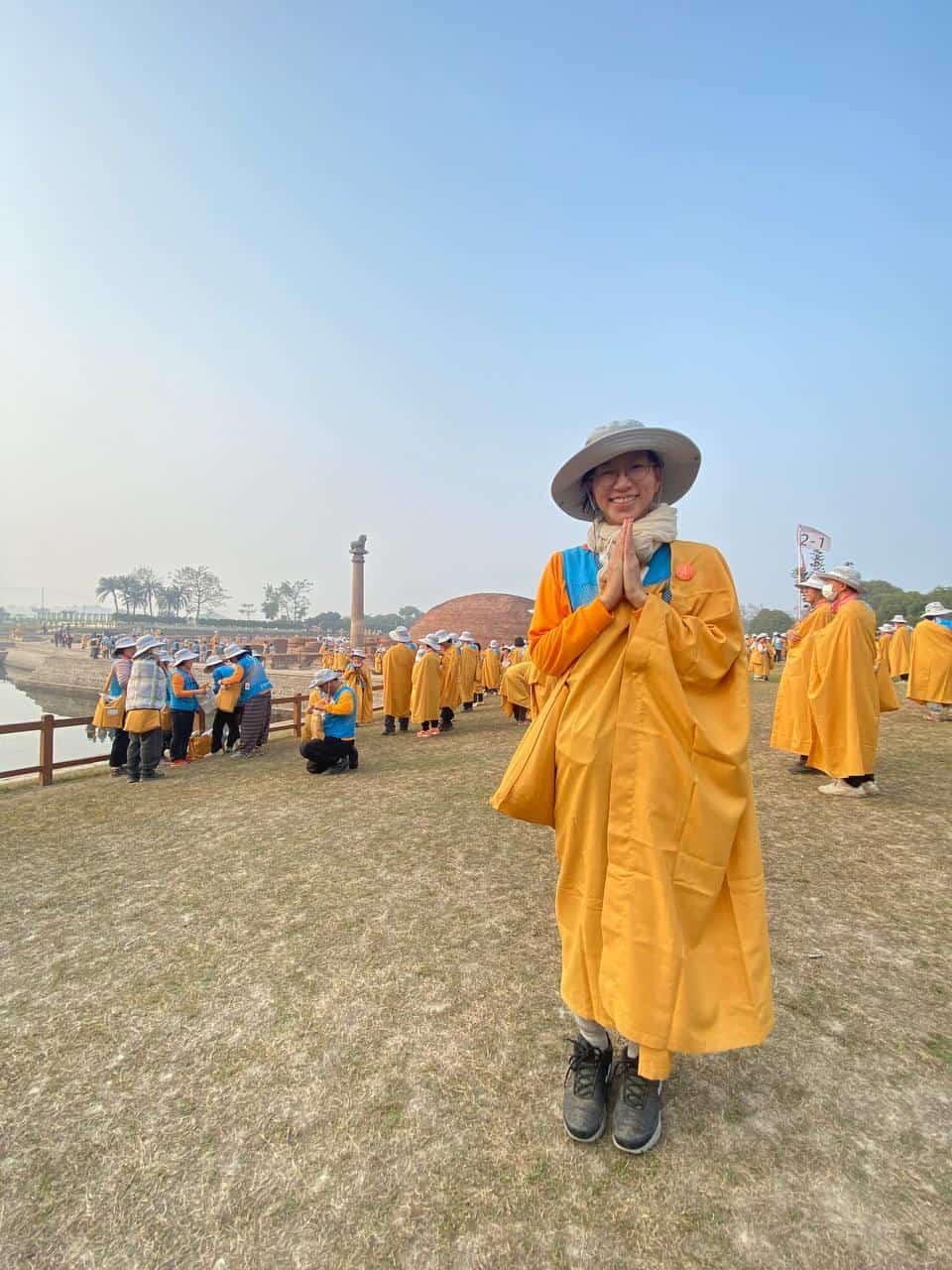
Curious about her transformation, and reassured by the low commitment of needing to attend for “just one month, four sessions total,” I decided to join the Happiness School with a light heart. The one-month program brought me many surprises. I became deeply interested in the foundation of this study and wanted to learn more. I went on to complete Jungto Dharma School programs and the training program for volunteers, and even participated in Jungto pilgrimage to the sacred sites in India. After serving as a facilitator five times, I now volunteer as an interviewer and as a coordinator for Jungto Dharma School.
My Mind Shattered into a Million Pieces and Reconfigured Anew
Jungto Dharma School shattered my mind into many pieces and then reassembled it. My perspective on life was redefined. The Buddhist concepts of suffering and happiness once felt like wordplay to me. How could happiness and suffering be one and the same? But then I realized that when I was excitedly chasing after a big goal, I called it happiness, and when I couldn’t, I called it suffering. I began to see where my suffering truly came from.
I had thought that a life was inevitably full of pain, and happiness was only an abstract idea that does not actually exist. But while volunteering as a Jungto Dharma School facilitator, I realized that life could become calm and abundant even without chasing after a goal or striving to grow. Happiness became real to me. The world outside the well was vast, yet I had been living trapped inside it, mistaking that small space for the entire world and struggling in vain.
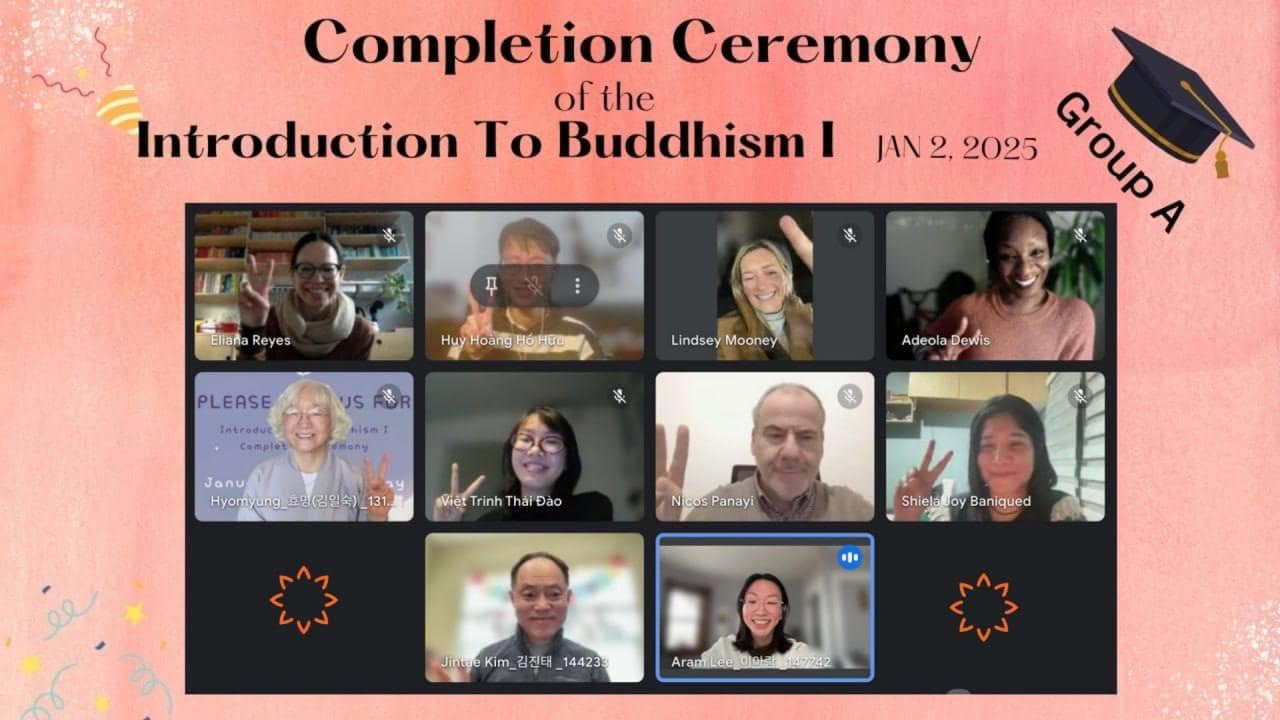
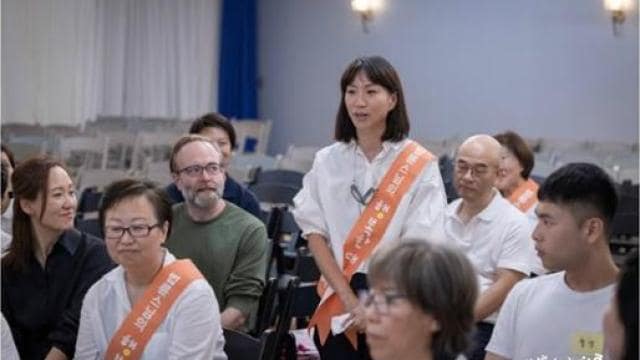
▲ Jungto Dharma School’s Graduation Ceremony, Aram Lee highlighted in blue
Doing What I Can, Here and Now
My Myeongshimmun (editor: directly translated as “words to remember” – they serve as a personal mantra to orient each Jungto practitioner) is, “Do what I can, here and now.” After graduating from middle school, you go to high school; after graduating from high school, you go to college. I lived my life constantly planning ahead, believing something terrible would happen if I ever stopped moving forward. I thought I had to make plans and live strictly according to them. But I learned that life doesn’t unfold just because you plan it that way, and that trying to simulate a distant future only heightens anxiety. When my mind becomes anxious by imagining the future, I recall my Myeongshimmun and focus on what I can do right now. The anxiety settles, and I become calm.
This Myeongshimmun has been a great help in my daily life. Because my work has no fixed schedule, there are times when everything piles up all at once and other times when there is no work at all. I used to think I wouldn’t be able to volunteer on a regular schedule, but I managed to overcome this thought by recalling the Myeongshimmun and telling myself, “Don’t look too far ahead. Just volunteer as much as you can right now.” Once I actually began volunteering, my time management became more organized. When work piles up and I start to feel rushed, I recall the Myeongshimmun; developing new products and working with that mindset makes the work flow more smoothly.
My Dream
Another volunteer asked me, “Is there something within Jungto Society you hope to do in the future?” At first, nothing in particular came to mind. Then suddenly, I got an idea: hosting and facilitating Jungto Dharma School classes with my American spouse.
In my marriage, I had always been self-righteous. When my husband wanted to purchase flower decorations for our wedding or repair a perfectly functioning bathroom just because he thought it looked old, those things seemed pointless to me. Whenever he was doing something useless or pointless from my perspective, I tried my very best to prove that I was right. If he didn’t accept my ways the first time, I repeated the same arguments a second, third, however many times it took until he agreed
Now, even when I argue heatedly, there are moments when I suddenly see myself from a third-person point of view, as if I’ve stepped outside myself. When that happens, my husband says, “You are actually being self-aware,” amused by the change in me. I also feel like I’ve softened a bit.
My husband still has not taken Jungto Dharma School yet. He has a laidback personality and doesn’t want to be tied to a program with a fixed schedule. Instead, he occasionally attends short workshops and Venerable Pomnyun Sunim’s English talks. I keep sending him videos and articles related to Venerable Pomnyun Sunim from time to time. Just as I used to skim past the things my older sister sent me, my husband now skims past what I send him. But just as there came a moment when I became curious about my sister’s transformed way of life, I believe there will come a moment when my husband becomes curious about the changes in me. When that time comes, maybe we’ll be able to host Jungto Dharma School classes together.
Translator’s note: Aram Lee’s spouse is currently enrolled in Jungto Dharma School.
—
Picturing Aram and her husband running Jungto Dharma School classes together warmed my heart. Following the interview, her Myeongshimmun, “Do what I can, here and now,” stuck with me. When I was writing her interview piece, the unstable domestic politics and economies in Korea around the presidential impeachment gave me anxiety. Like Aram, I reminded myself of her Myeongshimmun. I watered my house plants and focused on the tasks in front of me. That helped keep me away from anxiety.
—
Original article written by Myungjoo Koh (Jungto’s International Division, Pacific Asian Region)
Edited by Yunhee Kim (Jungto’s Korean Division, Kangwon-Eastern Kyungki Region, Yongin)
Translated by Hajeong Lim (Jungto’s International Division, North America-European Region) & Sanghoon Han (Jungto’s International Division, North America-European Region)